Best Fish for Small Tank? Nano Species That Actually Thrive in 5, 10, and 20 Gallons
The best fish for a small tank is the one that fits the tank size, not the one your kid pointed at in the pet store. Get the species right and a 5 gallon nano tank can run for years with minimal issues. Get it wrong and fish die in weeks.
The best fish for a small tank depends on the actual gallons. A 5 gallon tank fits a single male betta or a small school of chili rasboras. A 10 gallon fits ember tetras, neon tetras, endlers livebearers, or a honey gourami. A 20 gallon opens up community options with corydoras, harlequin rasboras, or pearl danios. The fish to avoid in any small tank: common goldfish (need 30 plus gallons), plecos (grow 18 to 24 inches), most cichlids, and any species over 3 inches as an adult. Cycle the tank for 4 to 6 weeks before adding any fish.
How to Pick Fish for a Small Tank
Small tank stocking is about three numbers: adult size, bioload (waste production), and schooling needs. The pet store tag almost never tells you adult size and never tells you bioload. Owners pick fish based on color and personality, then watch them die because the tank cannot support the species. According to Practical Fishkeeping, the leading cause of fish death in the first year is overstocking nano tanks with species that need larger water volumes.
The three rules that matter for small tanks:
- Adult size under 2.5 inches for tanks under 20 gallons
- Bioload low to moderate (not goldfish, not plecos)
- Schooling species need 6 plus tankmates of the same species
The "one inch per gallon" rule is misleading. A 3 inch goldfish has 10 times the bioload of a 3 inch worth of neon tetras. Tank shape matters too. A 5 gallon tall is a worse choice than a 5 gallon long because it has less surface area for gas exchange, which limits oxygen.
The other piece is cycling. Even the right species will die in an uncycled tank. Run the tank for 4 to 6 weeks with a bacterial starter and an ammonia source before adding fish. The AVMA aquatic medicine policy treats unstable water chemistry as the leading preventable cause of ornamental fish death. The full cycling protocol is in our post on why fish keep dying, which prevents 80 percent of beginner deaths.
Best Fish for a 5 Gallon Tank
A 5 gallon tank is genuinely small. Most fish do not belong in it. The species that do are bettas (one male only), chili rasboras (a school of 6 to 8), and shrimp colonies.
Male betta (Betta splendens). The most popular and most appropriate fish for a 5 gallon tank. Bettas have a labyrinth organ that lets them breathe air, so dissolved oxygen demand is lower than other fish. They prefer warm, still water (78 to 82 degrees) with low flow. A 5 gallon with a sponge filter, heater, and a few live plants is exactly what bettas thrive in. One male only (males fight). Females can sometimes be kept in sororities but require 20 plus gallons. Picky bettas have their own diagnostic protocol covered in our post on bettas refusing food.
Chili rasbora (Boraras brigittae). Tiny red fish that max out at 0.7 inches. A school of 6 to 8 fits comfortably in a 5 gallon with plants. They prefer soft, slightly acidic water and gentle filtration. Schooling behavior is the main reason to pick them: a tight school in a planted tank is one of the most beautiful nano displays.
Cherry shrimp (Neocaridina davidi). Not a fish, but a great 5 gallon inhabitant. A colony of 10 to 20 cherry shrimp in a planted tank is low-maintenance and breeds readily. Shrimp produce minimal bioload. They cannot live with bettas (will be eaten).
Nerite snails. Algae control without the bioload of a pleco. Nerites do not breed in freshwater so they will not overrun the tank. One or two per 5 gallon is plenty.
Best Fish for a 10 Gallon Tank
A 10 gallon opens up significantly more options. The extra surface area and water volume support more species and slightly bigger fish.
Neon tetra or ember tetra. A school of 6 to 8 neon tetras or 8 to 12 ember tetras is a classic 10 gallon stocking. Neons need soft acidic water and very stable conditions (they crash in unstable tanks, which is why so many die in beginner setups). Embers are slightly hardier and have a warm orange glow. Both species require a fully cycled tank before adding them.
Endler livebearer (Poecilia wingei). Smaller cousin of the guppy, max 1.5 inches. Brilliant coloration in males. A trio of one male to two females in a 10 gallon works, but be aware they breed prolifically. A male-only group avoids population explosion.
Honey gourami (Trichogaster chuna). A single honey gourami plus a school of small tetras fits in a 10 gallon. Honeys are peaceful and stay under 2 inches. They have the labyrinth organ like bettas, so oxygen demand is lower. Avoid dwarf gouramis (disease-prone) and pearl gouramis (too big).
Pygmy corydoras (Corydoras pygmaeus). A school of 6 pygmy corys is the bottom-dweller for a 10 gallon. They stay under 1 inch. Regular corydoras need bigger tanks.
Harlequin rasbora. A school of 6 in a 10 gallon works but pushes the limits. Better in a 15 or 20 gallon.
Best Fish for a 20 Gallon Tank
A 20 gallon is the sweet spot for beginner community tanks. You can finally have multiple species without overstocking.
Community tetra tank. A school of 8 neon tetras plus 6 ember tetras plus 6 pygmy corydoras plus a single honey gourami or 3 otocinclus. Beautiful, peaceful, manageable.
Cory tank. A school of 6 to 8 regular corydoras (panda, julii, or sterbai) plus a school of 8 harlequin rasboras or pearl danios. Bottom and middle activity, peaceful, hardy.
Endler community. A small breeding colony of endlers plus a school of pygmy corys and some shrimp. Active and easy.
Single-species displays. A school of 12 to 15 cardinal tetras, or 15 to 20 chili rasboras, or 6 to 8 lambchop rasboras. Large schools of nano fish in a planted 20 gallon look stunning.
Apistogramma pair. A single pair of dwarf cichlids (apistogramma cacatuoides, borellii, or agassizii) in a planted 20 gallon with tetras as dithers. Higher difficulty but rewarding.
Fish to Avoid in Any Small Tank
Some species are mis-sold for small tanks and almost always end badly. Owning these fish in nano tanks is a recurring source of cloudy water (covered in our cloudy fish tank fix post), oxygen crashes (covered in fish gasping at surface), and outright fish loss.
Common goldfish and fancy goldfish. Need 30 plus gallons for the first fish, 10 to 15 gallons per additional fish. Grow to 6 to 18 inches. Massive bioload. The bowl goldfish lives 1 to 3 years instead of the natural 10 to 25. The RSPCA fish welfare guidance calls goldfish bowls the single most persistent welfare problem in the hobby.
Common pleco (Hypostomus plecostomus). Sold as a "2 inch algae eater." Grows to 18 to 24 inches. Produces enormous waste. Needs 75 to 150 gallons. The right pleco for a nano tank is a clown pleco (4 inches, needs driftwood) or bristlenose (5 inches, OK in 20 plus gallons), but even these are pushing it.
Bala shark. Sold small, grows to 12 to 14 inches. Schooling fish. Needs 125 plus gallons.
Tinfoil barb. Sold small, grows to 12 inches. Active schooling fish. Needs 100 plus gallons.
Iridescent shark catfish. Sold small, grows to 3 plus feet. Pond fish, not aquarium fish.
Oscar, jack dempsey, and most large cichlids. Aggressive, large, high bioload. 55 plus gallons minimum.
Angelfish. Grow to 6 inches tall, need 29 plus gallons tall. Often sold as community fish but eat smaller tetras as adults.
Most "sharks" at the pet store. Red-tail, rainbow, and bala sharks all outgrow small tanks fast.
Equipment and Setup for a Nano Tank
Tank choice is the first piece. A 5, 10, or 20 gallon glass aquarium with an LED lid is the standard starting kit. Acrylic scratches easily. Bowfront and column tanks have less surface area than rectangular tanks and are less ideal.
Filter. Sponge filter (powered by an air pump) or hang-on-back filter rated for the tank size. Avoid undergravel filters in nano tanks (hard to clean). Match flow rate to fish: bettas and gouramis want low flow, barbs and danios want higher flow.
Heater. Adjustable heater rated 5 watts per gallon. A 25 watt heater for a 5 gallon, 50 watt for 10 gallon, 100 watt for 20 gallon. Cheap pre-set heaters fail often. Spend extra on a controllable heater with a digital readout.
Lights. LED lights with a timer. 8 hours per day for fish-only tanks, 10 to 12 hours for planted tanks. Tanks near windows need less light and risk algae blooms.
Substrate. Sand or fine gravel for most species. Avoid colored gravel for picky species (some leach dye). Plant substrates like ADA Amazonia or Fluval Stratum for planted tanks.
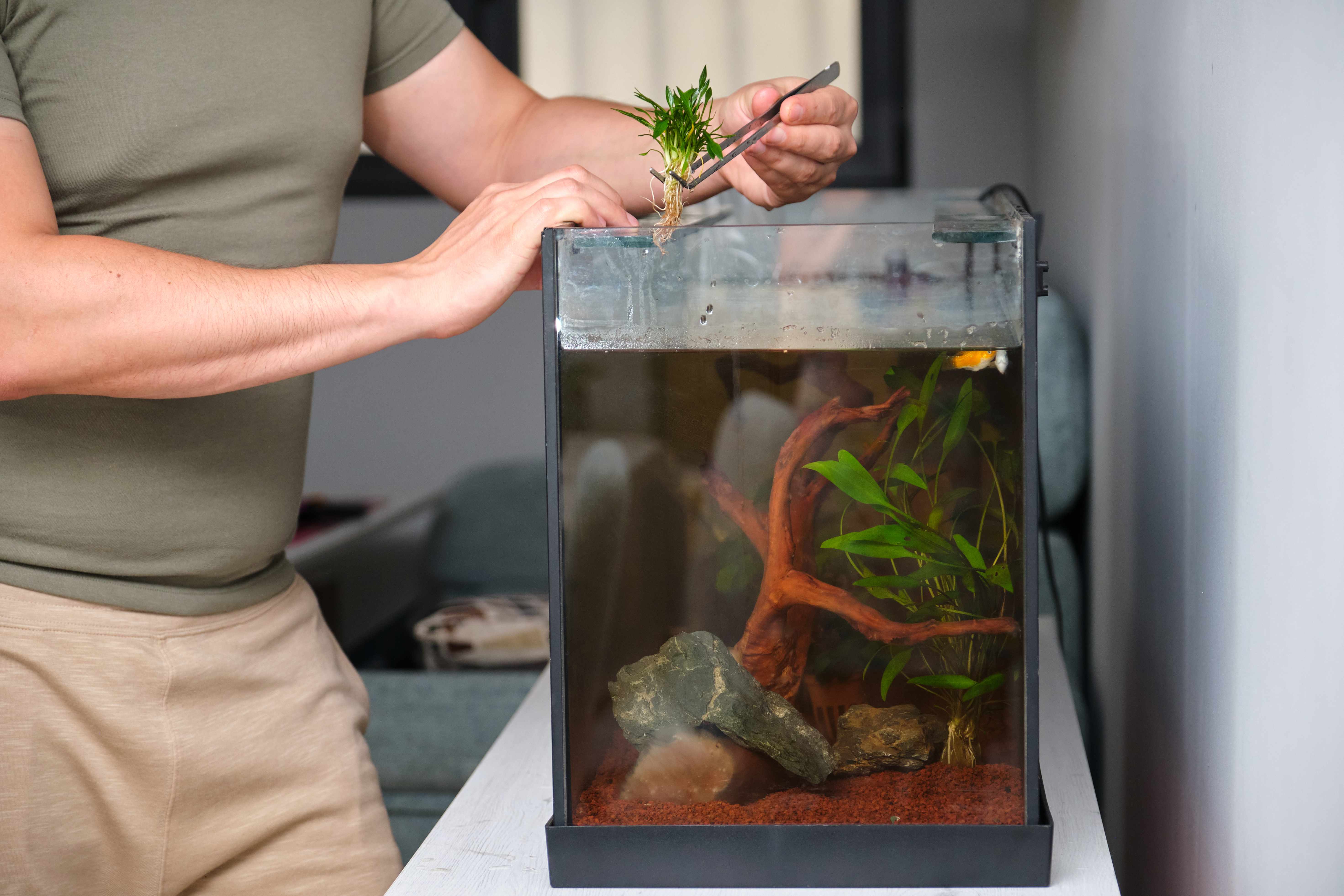
Plants. Java fern, anubias, java moss, and crypts are nearly impossible to kill and work in low-light tanks. Live plants compete with algae for nutrients and produce oxygen, which is why nano tanks with plants run more stable.
Test kit. Liquid API Master Kit or Salifert kit. Tests ammonia, nitrite, nitrate, pH. Strip tests are not accurate enough for cycling or emergencies.
Dechlorinator. Seachem Prime, API Stress Coat, or Tetra AquaSafe. Mandatory.
Air pump. Optional for most setups, mandatory for any tank running over 78 degrees or any sponge filter setup.
Day-by-Day Tank Setup Plan
Set Up the Tank
Rinse substrate, fill with dechlorinated water, install filter, heater, and lights. Run for 24 hours to check for leaks and equipment failure.
Start Cycling
Add plants if going planted. Add a bacterial starter (Seachem Stability or Tetra SafeStart). Add a small ammonia source (a pinch of fish food or pure ammonia dosed to 2 ppm).
Test for Ammonia
Test daily for ammonia. Ammonia will rise, then fall as bacteria establish. Add more bacterial starter every 2 days. Do not add fish.
Track Nitrite
Test for nitrite (should be rising). Ammonia should be dropping. Continue dosing ammonia source to keep bacteria fed.
Watch Nitrate
Test for nitrate (should be rising). Nitrite should be falling. Ammonia should hit 0.
Confirm Cycle
Test ammonia and nitrite. Both should read 0. Nitrate should be present (5 to 20 ppm). The tank is cycled.
Add First Fish
Do a 25 percent water change. Add the first fish, no more than 2 to 4 nano species. Observe for 1 week.
Add Second Batch
Add the next batch of 2 to 4 fish if water tests stable. Continue weekly stocking until target is reached.
Maintain
Full stocking reached. Weekly 25 percent water changes from here forward.
What Not to Do
- Do not buy fish on the same day you buy the tank. Cycle first, fish second.
- Do not stock based on the "one inch per gallon" rule. Use adult size and bioload.
- Do not buy common goldfish, common plecos, or bala sharks for a tank under 30 gallons.
- Do not put more than one male betta in a tank. They will fight to death.
- Do not skip the heater for tropical fish, even in a warm house.
- Do not use tap water without dechlorinator.
- Do not add fish all at once. Stock in small batches over weeks.
- Do not buy schooling fish (tetras, rasboras, danios) in groups under 6. Stress and death follow.
- Do not trust the pet store's stocking advice without verifying adult size online.
Frequently Asked Questions
For a 5 gallon tank, a single male betta or a small group of chili rasboras is the best choice. For a 10 gallon, ember tetras, neon tetras, endlers livebearers, and a single honey gourami all work. For a 20 gallon, you can keep a community of small tetras, harlequin rasboras, or a sorority of corydoras. Avoid goldfish, plecos, and most cichlids in any tank under 30 gallons.
No. Goldfish need 30 gallons minimum for the first fish and 10 to 15 gallons per additional fish. Fancy goldfish grow to 6 to 8 inches and produce massive bioloads. The bowl and 5 gallon goldfish setup is the leading cause of premature goldfish death (lifespan 1 to 3 years instead of the natural 10 to 25).
A 5 gallon tank holds one male betta plus a small cleanup crew, or 6 to 8 chili rasboras alone, or a colony of cherry shrimp. The old rule of one inch per gallon is wrong because it ignores fish width, activity, and waste production. Stick to nano species under 1.5 inches and keep total fish count low.
Bettas, white cloud mountain minnows, endlers livebearers, and platies are the most beginner-friendly. They tolerate a range of water parameters and forgive feeding mistakes better than fragile species like neon tetras or discus. Always cycle the tank for 4 to 6 weeks before adding any fish, even the hardiest.
Yes, a school of 6 to 8 neon tetras fits in a 10 gallon tank with stable water parameters. Neons need soft, slightly acidic water (pH 6.5 to 7.0) and very stable conditions. They are sensitive to ammonia, nitrite, and pH swings, so the tank must be fully cycled before adding them.
Yes. Bettas are tropical and need water between 76 and 82 degrees Fahrenheit. Without a heater in a room cooler than 76, bettas become lethargic, lose color, stop eating, and develop fin rot. A small adjustable 25 watt heater is enough for a 5 gallon tank.
Cherry shrimp and amano shrimp can live with small peaceful fish like ember tetras, chili rasboras, or pygmy corydoras. They cannot live with bettas (will be eaten), most barbs, or any cichlid. Heavy planting and hiding spots help shrimp survive in fish tanks.
Common plecos grow to 18 to 24 inches and produce enormous waste, so they need 75 to 150 gallon tanks. The "algae eater" sold as a small fish at pet stores is misleading. For nano tanks, otocinclus catfish (under 2 inches) or nerite snails are the right algae control choice.
A new tank needs 4 to 6 weeks of cycling before adding fish. Cycling builds the beneficial bacteria that convert ammonia to nitrate. Use a bacterial starter (Seachem Stability, Tetra SafeStart) and a source of ammonia (pure ammonia or fish food) to feed the bacteria during cycling. Test daily for ammonia, nitrite, and nitrate.
The Bigger Picture
The best small-tank setup is a cycled, planted nano with one carefully chosen species or a small community of nano species. A 5 gallon with a betta. A 10 gallon with ember tetras and a honey gourami. A 20 gallon with a tetra community and corys. These setups can run for years with minimal trouble when the basics are in place. Most small-tank failure comes from species choice (goldfish in a 5 gallon, pleco in a 10 gallon) or skipped cycling. The diagnostic for chronic fish loss is in why fish keep dying, and the protocol for the cloudy water that often follows overstocking is in the cloudy fish tank fix. If you do pick a betta and the betta stops eating, the protocol is in the betta refusing food post. Surface gasping in any species traces back to oxygen, ammonia, or temperature, and that protocol is in the surface gasping post.
Every tank is different based on size, water source, and the species you want to keep. PawMatch AI factors in your tank size, water source, and species goals to recommend the exact filter, heater, test kit, and starter livestock that fit. Free, takes 30 seconds.
Stop Guessing. Get Matched.
Every tank is different. PawMatch AI uses your tank size, water source, and species goals to recommend the exact filter, heater, test kit, and starter livestock that fit. Free, personalized, takes 30 seconds.
Find My Fish's Match →