Why Does My Dog Sit on Me? 4 Real Reasons and What It Says About Your Bond
Dogs sit on their humans for bonding, scent, guarding, and attention, in that order of frequency. Read the body language and you will know exactly what your dog is saying.
Dogs that sit on their owners are almost always doing one of four things: seeking security and bonding through contact, lightly scent-marking a trusted social anchor, guarding the owner as a resource against other pets or people, or actively asking for attention. The dominance interpretation that lingers in old training books has been formally rejected by every credentialed behaviorist group. The work is reading body language to know which of the four drivers your dog is acting on, and adjusting the response so the behavior stays healthy. Most lap sitting is normal and good. A small share crosses into guarding and benefits from training.
Why Dogs Sit on People
Start with the species. Dogs are pack-living social mammals that evolved to physically contact other members of their group during rest. Pack sleeping piles, leaning, touching paws, lying back-to-back: all of these are normal canine behaviors that get redirected onto human social partners in the household. The American Kennel Club describes leaning and sitting on owners as one of the clearest signals of social bonding in domestic dogs.
Four real reasons, ranked by frequency:
- Security, warmth, and bonding (the largest share)
- Light scent marking through paw and anal gland scent transfer
- Resource guarding (the owner is the resource)
- Attention seeking that has been accidentally reinforced
Old training literature added a fifth, "dominance." This idea was based on a flawed 1970s wolf study that the original author later publicly retracted. Modern behavioral science across VCA, the ASPCA, and the American College of Veterinary Behaviorists has rejected the dominance interpretation. Your dog is not climbing a hierarchy. They are getting close to you.
Security, Warmth, and Bonding
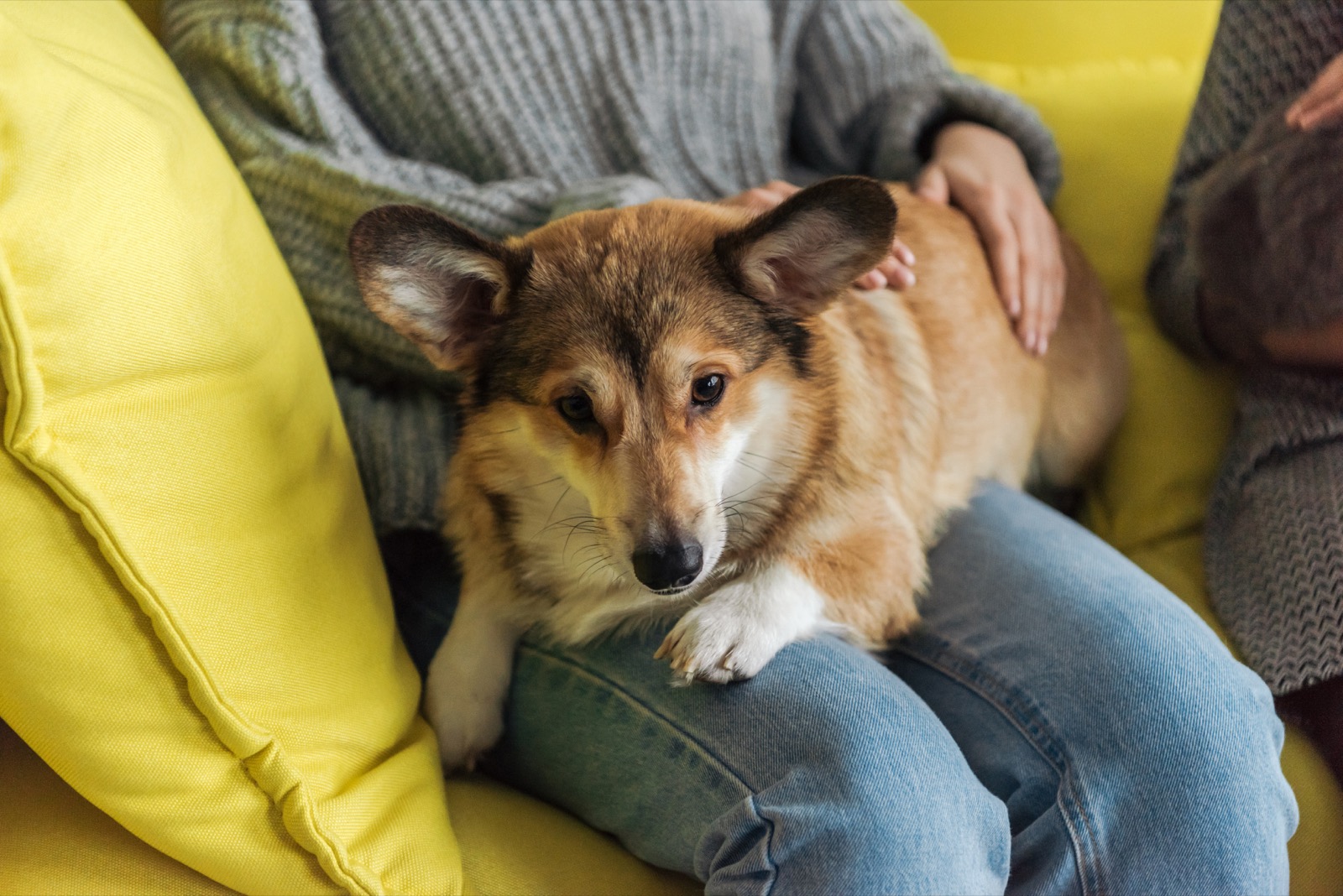
This is the biggest bucket and the simplest one. Your dog likes you, feels safe near you, and physically contacting you regulates their nervous system. Sitting on you also keeps them warm, gives them a clear view of the room, and means they know the second you stand up. For dogs, sustained physical contact with a trusted person reduces heart rate and cortisol the same way petting a dog reduces stress in humans. The relationship is symmetrical.
Signs security and bonding is the driver:
- Dog is relaxed: loose body, soft eyes, possibly snoring
- Easily moves when you stand up, no resistance
- No reaction when other family members or pets approach
- Sits on you primarily during quiet times (TV, reading, sleeping)
- Often does the same with other trusted humans
Light Scent Marking
Dogs have scent glands in their paws (interdigital glands) and around the anal area. Sitting on someone or something transfers a small amount of scent and reinforces social bond from a chemical standpoint. This is sometimes called "mingling scents" in behavior literature. It is not the same as urinary marking and it is not a sign of any problem.
Signs scent marking is in play:
- Dog scratches lightly with back paws before settling on you (rare but does happen)
- Picks the spot you sit on most often, even when you are not there
- Behavior intensified after introducing a new person, pet, or returning home from boarding
- Often combined with light face-rubbing on the same spot
- Lap-sitting is paired with relaxed sniffing of your clothes or hair
Resource Guarding
This is the small but important slice. Resource guarding of people is a real behavioral issue where the dog treats the owner as a high-value resource and behaves defensively toward other dogs, cats, family members, or visitors. The dog sits on the owner partly because they enjoy it, partly to occupy a position that physically blocks others from approaching. The behavior often starts subtle (stiffening when another pet enters the room) and can escalate over months.
Signs resource guarding is the driver:
- Dog stiffens, hard-stares, or growls when another pet or person approaches you while they sit on you
- Glances sideways at the approaching party without lifting their head (whale eye)
- Tries to wedge between you and your partner on the couch
- Resists being moved off your lap
- Snaps if a child or another dog tries to climb up too
- Other guarding behaviors elsewhere in the house (food bowl, toy, sleeping spot)
Attention Seeking (Accidentally Reinforced)
Some dogs sit on their owners because they have learned, through hundreds of repetitions, that sitting on you produces petting, food, eye contact, conversation, or any other form of attention. This is the same mechanism that creates begging at the table and pawing for affection. The dog is not being manipulative. They are being a brilliant pattern-detector.
Signs attention seeking is the driver:
- Dog jumps on you the moment you sit down
- Pushes into your hands or face when on your lap
- Stops the moment you successfully ignore them and starts again when you respond
- Will repeat the behavior across multiple family members
- Often paired with other attention-getting moves (pawing, vocalizing, dropping toys on you)
7-Day Plan to Read and Reshape the Behavior
Observe and Label
For 24 hours, every time the dog sits on you, note: how did they get there (invited or self-launched), what is their body like (loose or stiff), and how do they react to interruptions. This is your diagnostic data.
Body Language Audit
Watch what happens when another pet or family member approaches. Stiffening, hard staring, growling, or sideways glances mean you are in resource guarding territory. Loose, floppy, sleeping means pure bonding.
Test the Move-Off
Calmly say "off" and gently lift or guide the dog down. Note the response. Easy, immediate compliance is normal. Resistance, growling, or refusal is a flag.
Set Up the Alternative
Place a comfortable bed within sight of where you usually sit. Reward voluntary use heavily for 3 days with high-value treats.
Put Lap Sitting on Cue
Pick an invite word ("up" or "cuddle"). When you want the dog up, say the cue and pat the spot. When you do not, no cue, no pat. The dog learns that the lap is available by invitation.
Reinforce the Alternatives
When the dog chooses their bed over your lap, reward heavily. The mat does not have to compete with you; it just has to pay enough that the dog accepts it as an option.
Decide
Normal bonding pattern? Continue freely. Attention seeking pattern? Stick with the cued-only protocol for another 2 to 3 weeks. Resource guarding signs? Schedule a session with a credentialed force-free trainer or veterinary behaviorist.
What Not to Do
- Do not punish, push, or yell when the dog sits on you. Punishment for affection produces anxiety, not boundaries.
- Do not use dominance language or alpha-roll techniques. They have been formally rejected by every credentialed behaviorist group and they increase aggression risk.
- Do not allow lap sitting when you have visible food or are eating, unless you want to teach food guarding behavior.
- Do not let small children put their faces in a lap-sitting dog's face. Even bonded dogs can snap when startled at close range.
- Do not assume growling on the lap is "grumpy old dog." Growling is communication; suppressing it removes the warning and leads to silent bites later.
- Do not give the dog conflicting rules. Allowed on the couch by one family member and shooed off by another produces an anxious, confused dog.
- Do not assume the behavior will fix itself once a baby arrives or a new pet comes home. Address resource guarding before a household change, not after.
Frequently Asked Questions
Dogs sit on their owners for four main reasons: security and bonding (the most common), scent marking, resource guarding behavior toward other pets or people, and attention seeking. About 75 percent of cases are pure affection and trust. Context matters: a relaxed dog on your lap is bonded, a tense dog blocking access to you is guarding.
Almost never. The dominance theory of dog behavior is outdated and has been formally rejected by veterinary behaviorists. Dogs sit on people for closeness, warmth, security, and bonding, not to assert rank. Watch the body posture: relaxed and floppy is affection; stiff and watchful while sitting on you is resource guarding, which is a different problem.
Many large breeds are wired for close human contact, especially Labradors, Golden Retrievers, Great Danes, and Saint Bernards. Size does not change the bonding drive. If you allowed it as a puppy, the behavior continues into adulthood as a 70 pound lap-seeker. It is normal bonding behavior, not confusion.
Yes, if you both enjoy it and the dog gets off when asked. Boundaries matter when the dog cannot tolerate being moved, growls when another pet approaches, or refuses to settle anywhere else. Otherwise, sitting on you is healthy social behavior. Be consistent: if you do not want it sometimes, you should not allow it ever.
Sitting on feet is anchoring behavior. The dog knows where you are even without looking and gets a heads-up if you move. It is a bonding posture often seen in working breeds and herders. It can also be insecurity when in an unfamiliar environment, where the dog uses contact as a safety anchor.
Chest sitting is the strongest contact-seeking posture. Many dogs do it to sync to your breathing and heartbeat, which has a calming effect on both parties. Small dogs are especially prone to this. If the dog becomes territorial about the chest position or growls at a partner approaching, the meaning shifts to resource guarding.
Possibly, in a mild way. Dogs have scent glands in their paws and around their anal area. Sitting on you transfers light scent and reinforces social bond from a chemical standpoint. This is not the same as urinary marking and is not a problem behavior unless paired with stiff guarding posture.
It becomes a problem if the dog growls at other people or pets approaching, refuses to move when asked, becomes anxious when not on you, or guards the lap as a resource. Resource guarding of people is a real behavioral issue that benefits from working with a credentialed force-free trainer or veterinary behaviorist.
Dogs often pick a primary attachment figure within the household and prefer their lap. This is normal social preference and usually correlates with the person who feeds, walks, or interacts most with the dog. It is not a rejection of others, just a stronger bond with one. The preference can shift over months as routines change.
The Bigger Picture
A dog that sits on you is, in almost every case, telling you something good about your relationship. The species spent thousands of years selecting for closeness with humans, and lap sitting is one of the cleanest expressions of that wiring. The work is reading body language well enough to spot the small percentage of cases that have crossed into resource guarding, and adjusting before the behavior escalates. Many dogs that lap sit heavily also shadow you everywhere, and the two together usually point to healthy attachment in well-adjusted dogs and to anxiety in others. The same dogs sometimes show their stress through skin behaviors like constant paw licking, so cross-check there if your dog seems wound tight even when on your lap. Bonding patterns are set early, and the first-week puppy mistakes often determine whether an adult dog can settle alone or not. If your dog is sitting on you constantly out of a lack of input, the signs your pet is bored guide will tell you fast.
Every dog's attachment style is different. PawMatch AI factors in your dog's breed, age, environment, and behavior profile to recommend the exact beds, enrichment, and training tools that fit. Free, takes 30 seconds.
Stop Guessing. Get Matched.
Every dog is different. PawMatch AI uses your dog's age, breed, behavior, and home setup to recommend the exact beds, enrichment, and training tools that fit your dog's bonding style. Free, personalized, takes 30 seconds.
Find My Dog's Match →