Cat Bites Then Licks Me? What Love Bites Really Mean and How to Read the Warning Signs
The bite-then-lick combo is one of the most confusing things cats do. It is almost always one of five distinct behaviors, and once you can read the difference, the painful bites stop within a week.
Cats bite then lick for five reasons: gentle social grooming bites, overstimulation aggression when petting becomes too much, play aggression in young or under-stimulated cats, redirected aggression from an unseen trigger, and learned attention seeking. The follow-up lick is rarely apology, it is allogrooming, a normal way cats reinforce social bonds. The fix is reading the warning signs in the 2 to 5 seconds before the bite and redirecting prey drive into structured play. Hard bites that break skin require medical attention within hours.
Why Cats Bite and Then Lick
Cats live in a world of touch hierarchies that humans do not naturally see. In a multi-cat colony, cats greet, sniff, head-bunt, groom, and occasionally nibble each other in a constant low-grade choreography. A soft bite during mutual grooming is the cat version of a friendly poke. A hard bite during petting is the cat saying you crossed a sensory threshold they cannot tolerate.
International Cat Care frames cat social behavior around affiliative bonds and stress signals, and notes that even friendly contact has a finite tolerance window that differs between individuals. The ASPCA aggression guide groups cat-on-human aggression into categories that map cleanly onto the bite-then-lick puzzle: petting-induced, play, redirected, and fear-based.
The five most common reasons your cat bites then licks, ranked by frequency:
- Social grooming (love bites) and allogrooming
- Petting-induced overstimulation aggression
- Play aggression and prey drive misdirected at hands
- Redirected aggression from an unseen trigger
- Attention seeking from learned reinforcement
Soft no-mark nibbles are almost always cause 1. Bites that leave a divot are causes 2 to 4. Bites timed perfectly with food bowl emptiness are cause 5.
Social Grooming and Love Bites
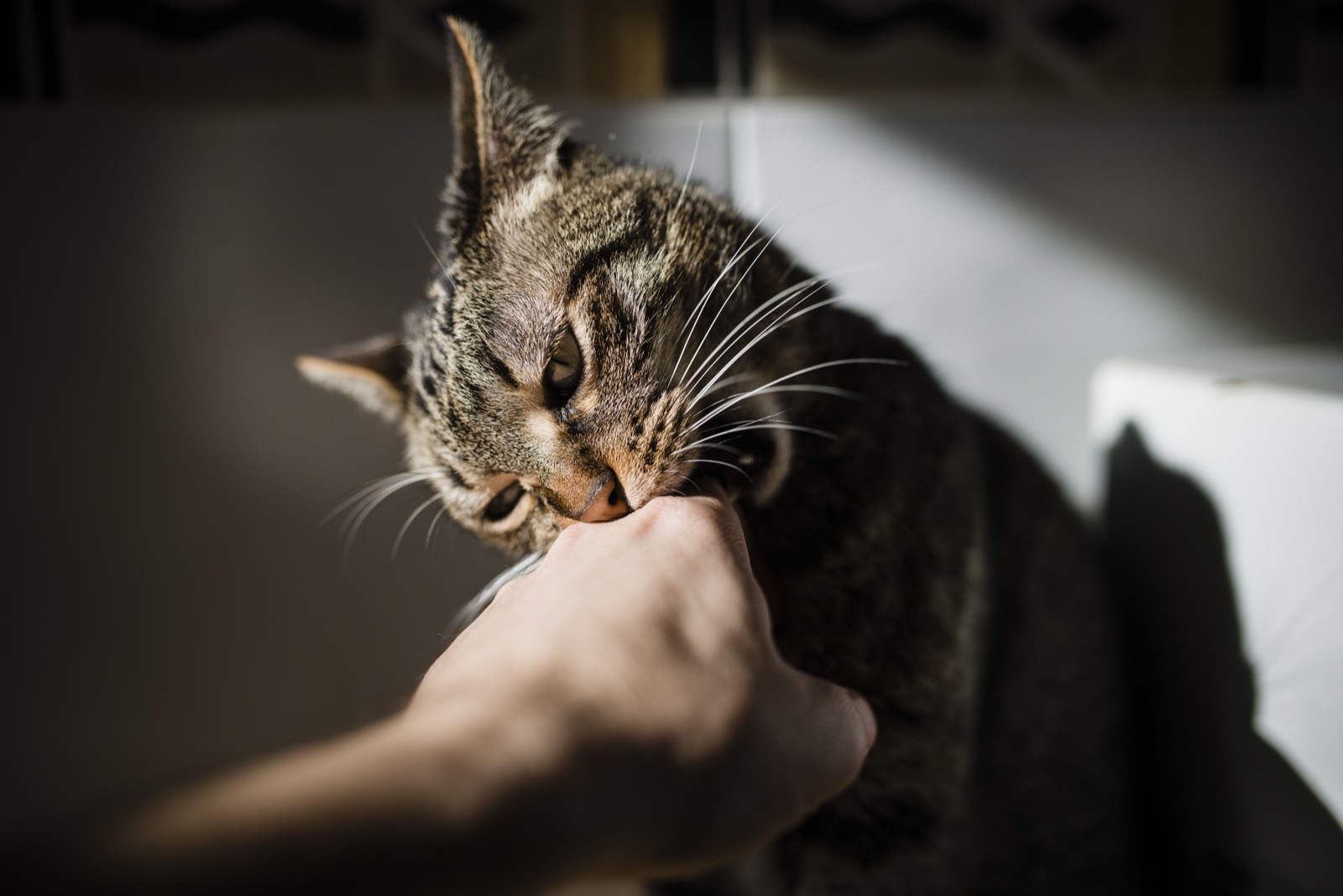
Cats that live together groom each other. They lick the head, neck, and ears of bonded companions in a behavior called allogrooming. Embedded inside that grooming is occasional gentle mouthing of the partner's fur or skin. There is no aggression, no pressure, and no broken skin. It is closer to a kiss than a bite.
When your cat does this to you, they are treating you as a grooming partner. The lick before, during, or after is the headline behavior, and the soft mouthing is part of the same package. Many cats use very soft pressure intentionally, demonstrating bite inhibition they learned as kittens.
Signs love biting is the trigger:
- Bite is soft, no skin marks, no pain
- Paired with licking before or after
- Cat's body is relaxed, tail soft, eyes half-closed or slow-blinking
- Often happens when you are still and the cat is settled near you
- Bite targets fingers, knuckles, or the side of your hand
- Cat does not run after the interaction, often stays curled up
Petting-Induced Overstimulation Aggression
This is the most common painful bite and the most misunderstood. Your cat hops on your lap, purrs, asks for petting, and 90 seconds in clamps down on your hand. Owners read this as random or moody. It is not. It is a sensory tipping point, and there were warnings.
Cats have highly sensitive skin and a finite tolerance for repetitive touch in one location. Long strokes down the back, belly contact, or petting at the base of the tail accumulate sensory input fast. When the cat hits its threshold, the same stroke that felt good five seconds ago now feels irritating. The bite is the cat saying enough, often after they tried softer signals and were ignored.
Signs overstimulation is the trigger:
- Tail tip begins twitching or thumping
- Skin along the spine ripples or twitches
- Ears rotate sideways or flatten back
- Pupils dilate from slits to wide
- Body tenses and freezes
- Head turns sharply toward your petting hand
- Bite happens after 30 seconds to 3 minutes of continuous petting
Play Aggression and Misdirected Prey Drive
Young cats, single cats, and indoor cats with under-stimulating environments often funnel their entire predatory drive into the only moving thing in the apartment: you. Hands become prey. Ankles become prey. Your face at 6 a.m. becomes prey. The bite is part of the kill sequence, not a communication signal.
The follow-up lick in this case is often part of the post-kill grooming a cat does after catching prey. They have rehearsed the full sequence on your hand and the lick is the final step. It does not mean affection, it means they completed the prey loop.
Signs play aggression is the trigger:
- Cat is under 3 years old, often under 1
- Cat is alone with no feline playmate
- Pupils fully dilated before the bite
- Tail held low and twitching, body in a low crouch
- Ambushes from under furniture or around corners
- Bite is firm, sometimes followed by bunny-kick scratching
- Cat zooms away after, often zooming through the apartment at night
Redirected Aggression
A cat at the window sees an unfamiliar cat in the yard. Heart rate spikes. Adrenaline floods. Then you walk by and pet them. The cat cannot reach the cat in the yard, so the aggression aimed at the intruder lands on you instead. The bite can be severe and the cat may not stop with one strike.
The lick after redirected aggression often comes minutes to hours later, once the cat's arousal has fully come back down. It is the cat re-bonding after the episode. The bite was never personal, it was a chemistry overflow.
Signs redirected aggression is the trigger:
- Bite is sudden, hard, and out of character
- Cat was just at a window, on a balcony, or in another arousing situation
- Pupils fully blown, body in fight stance
- Cat may growl or hiss in the moments after
- Episode can last 5 to 30 minutes of altered behavior
- Bite is often paired with a swipe of claws
- The lick or affection happens later, after the cat has truly calmed
Attention Seeking and Learned Reinforcement
If you ever responded to a bite by giving food, opening a door, picking the cat up, or making a big vocal reaction, congratulations, you taught your cat that biting works. Cats are learning machines and intermittent reinforcement is the strongest training schedule there is. The bite is not really aggression anymore at this point, it is communication you accidentally trained.
The lick afterward is usually social, the cat got what they wanted, the conflict resolved, and now they are bonding with you again. Your cat is not being a jerk, they are operating on a contract you signed without reading.
Signs attention seeking is the trigger:
- Bites are predictable in timing (always near meal time, always when you are on a laptop)
- Bites are calibrated, more like a pinch than a real bite
- Cat looks at you immediately after, waiting for response
- Behavior started after a specific event (you started working from home, a new pet arrived)
- Stopping all reaction reduces the behavior
7-Day Plan to Read and Redirect Cat Biting
Observe and Map
Observe without intervening. Track each bite: time, what you were doing, what part of the body you touched, and the 5 seconds before the bite. Look for tail twitches, skin ripples, and ear position. You are building a map.
Shorten Petting
Cut petting sessions in half. Three short bursts of 20 seconds each, with pauses between. Focus on head, cheeks, and under the chin. Avoid the belly, base of tail, and lower back. Note how the cat responds to shorter sessions.
First Play Session
Add the first structured play session, 10 to 15 minutes with a wand toy. End with the cat catching the toy, then offer a small meal or treat. Note if the evening is calmer.
Add Second Play Session
Add the second structured play session, in the morning or late afternoon. Two sessions, separated by hours, drain prey drive far more than one long session.
Practice Reading Signals
Practice reading the warning signals in real time. Stop petting at the first tail twitch. Praise calmly when the cat stays settled after you stop. The cat is learning that you can read them, which lowers the need to bite to communicate.
Block Triggers
Block redirected-aggression triggers if applicable. Close blinds during dusk if outdoor cats are visible. Use Feliway diffusers in high-tension areas. Note if outbursts decrease.
Evaluate
Most healthy cats show a 70 to 90 percent drop in painful bites by Day 7 of consistent boundary reading and play redirection. Continue the routine for another 2 to 3 weeks to solidify the new patterns. If hard bites continue daily despite this protocol, consult a vet to rule out pain (especially arthritis, dental disease, or skin sensitivity) and consider a certified feline behaviorist.
What Not to Do
- Do not yell, hit, or scruff a biting cat. Punishment increases anxiety and creates more bites, not fewer. It also breaks the bond you are trying to repair.
- Do not use your hands as toys at any age. Once a cat learns that hands are prey, that wiring is permanent.
- Do not spray water as punishment. It creates fear of you, not understanding of the behavior.
- Do not pet a cat that is in a window-watching, tail-puffed state. Wait until they have visibly calmed.
- Do not push past warning signals. Tail twitch means stop, not "keep going gently."
- Do not assume a senior cat that suddenly starts biting is "just grumpy." Pain from arthritis, dental disease, or hyperthyroidism causes new-onset biting. Check with a vet.
- Do not let a serious bite go untreated. Cat bites that break skin require antiseptic cleaning and often a doctor's visit within 8 hours.
Frequently Asked Questions
It is one of five things: a soft love bite during social grooming, overstimulation aggression from too much petting, play aggression in a young cat, redirected aggression after an outside trigger, or learned attention seeking. The follow-up lick usually signals affiliative grooming, not apology.
A love bite is a gentle, no-pressure mouthing of your hand or finger during grooming or close contact. It does not break skin, does not leave marks, and is often paired with licking, slow blinks, and a relaxed body. It is part of cat allogrooming behavior.
Petting-induced aggression, also called overstimulation, is one of the most common bite triggers. The cat enjoys initial petting, sensory input piles up, and at a tipping point the touch flips from pleasant to irritating. The bite is the cat saying enough. Body-language warnings always come first.
Soft no-pressure mouthing during mutual grooming is normal cat communication and harmless. Any bite that breaks skin, leaves marks, or escalates in intensity should be redirected. Adult cats should learn that human skin is not a play target.
Read the warning signs (tail twitch, flattened ears, skin ripples) and stop petting before the bite. Redirect play to wand toys, never use hands as toys, end interaction calmly without yelling, and run two structured 10-minute play sessions daily to drain prey drive.
Cats groom social partners as bonding behavior, called allogrooming. The bite-then-lick pattern is often a normal social sequence in feline communication, not an apology in the human sense. It signals that the cat still considers you part of the social group.
Twitching tail tip, rippling skin along the back, flattened or rotated ears, dilated pupils, frozen posture, and a sudden head turn toward the petting hand. Any one of these means stop. Most owners miss them because they happen in the 2 to 5 seconds before the bite.
Usually attention seeking or hunger if the bite is targeted at a hand or face in the morning. Sometimes pure play if you have a young cat. The fix is to never reinforce by feeding or playing in response. Confine the cat outside the bedroom if necessary.
Cat bites that break human skin carry a high infection risk, particularly on hands and joints. Pasteurella bacteria from cat mouths cause rapid cellulitis. Any bite that draws blood needs cleaning, antiseptic, and a call to your doctor within 8 hours, sooner if the wound is on a hand or wrist.
The Bigger Picture
The bite-then-lick cycle is one of the most misread cat behaviors in homes. Most owners assume it is moodiness or unpredictability. It is neither. It is a cat communicating in a hierarchy of touch and arousal that humans simply do not see by default. The fix is almost never punishment, it is paying attention to the 5 seconds before the bite and respecting what your cat is telling you.
Cat behaviors cluster. The same cat that bites during petting often also redirects prey drive into scratching the furniture, shows other signs of indoor boredom, or has bonding rituals like sleeping on your head. A cat that suddenly starts biting and also begins staring at walls is showing two symptoms of the same arousal or sensory issue and should be seen by a vet for hyperesthesia and pain screening.
Every cat has different touch tolerances, prey drives, and stress thresholds. PawMatch AI factors in your cat's breed, age, environment, and personality profile to recommend the exact play tools, calming aids, and enrichment that fit cats like yours. Free, takes 30 seconds.
Stop Guessing. Get Matched.
Every cat is different. PawMatch AI uses your cat's age, breed, behavior, and home setup to recommend the exact wand toys, calming aids, and enrichment that redirect bite-and-lick energy into healthy play. Free, personalized, takes 30 seconds.
Find My Cat's Match →