Cat Staring at Wall? The 4 Real Causes and When to Worry
Wall-staring in cats has four real causes, and only one of them is concerning. Identify which one your cat is showing and you will know in 30 seconds whether to ignore it or call the vet.
Cats stare at walls for four main reasons. The most common is prey drive triggered by sounds or movement humans cannot detect, since cats hear into the ultrasonic range and notice tiny vibrations through walls. The second is feline cognitive dysfunction in senior cats, where wall-staring is a documented dementia sign. The third is feline hyperesthesia syndrome, an episodic neurological condition with twitching and fixation. The fourth is vision change, where cats stare more as sight declines. Worry only if the staring is prolonged, paired with disorientation, or appears in a senior cat without a clear external trigger.
Why Cats Stare at Walls
The first thing to know is that cats live in a sensory world humans cannot perceive. The International Cat Care authority on feline behavior is explicit on this point: cat senses operate at frequencies, speeds, and intensities the human nervous system cannot match. Cats hear up to 64 kHz. Humans hear up to about 20 kHz. Cats see ultraviolet wavelengths, detect movement at twice the speed of human flicker fusion, and perceive vibration through their whiskers and paw pads at scales we cannot.
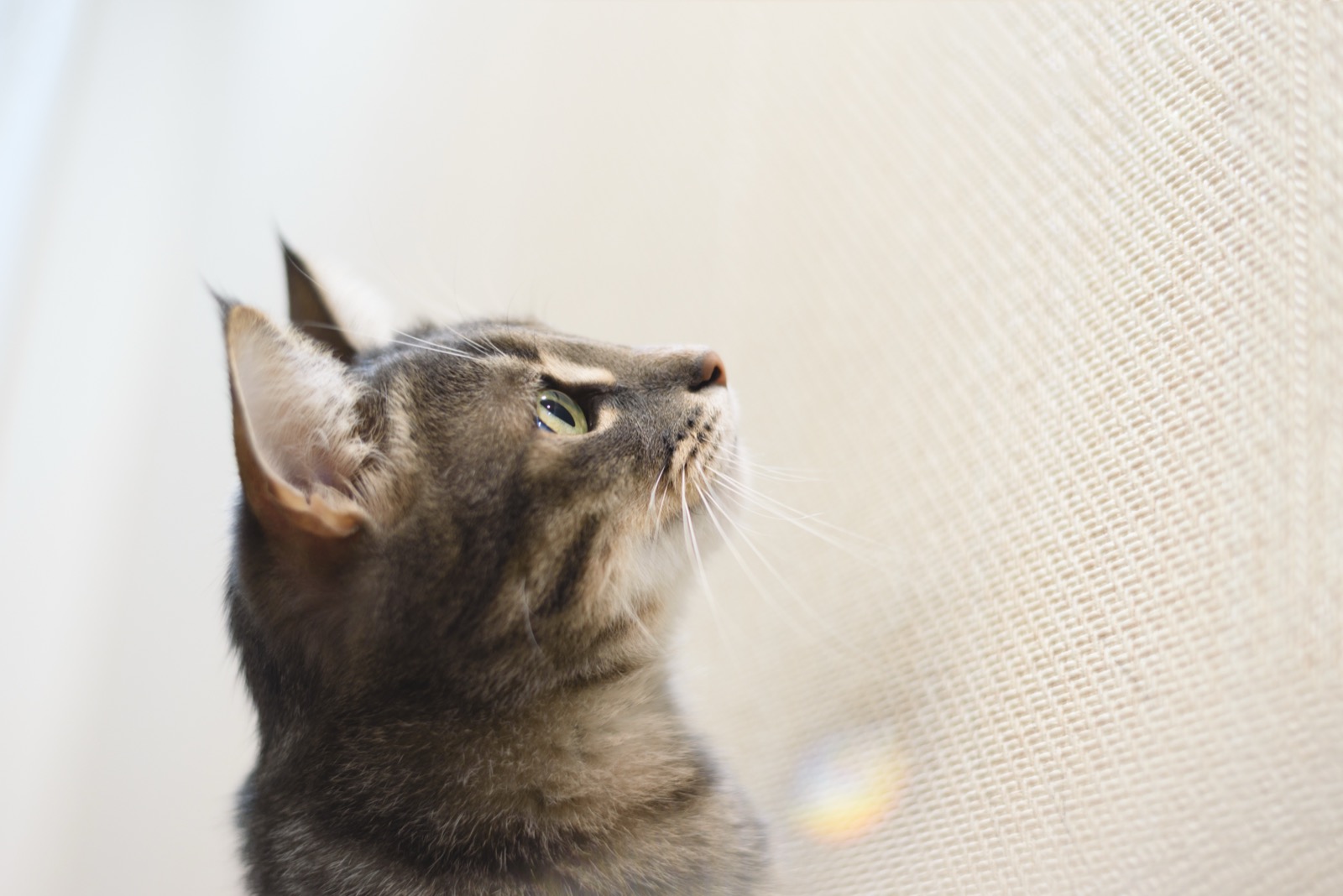
When a cat stares at a wall, the cat is often responding to something real. Real sounds. Real vibrations. Real micro-movements. The fact that the wall looks blank to you does not mean it is blank to the cat. This is why most wall-staring in healthy adult cats is normal hunting behavior, not a sign of anything wrong.
Four causes account for nearly all wall-staring:
- Prey drive triggered by small sounds, vibrations, or movement
- Feline cognitive dysfunction (senior cat dementia)
- Feline hyperesthesia syndrome
- Vision change
The first cause is normal. The other three are medical. Distinguishing between them is what this guide does.
Prey Drive (Sounds and Movement You Cannot Detect)
This is by far the most common cause of wall-staring in cats under 10 years old. Cats are obligate hunters with the sensory equipment to detect prey through walls, in walls, behind walls, and inside walls. A mouse skittering inside the wall cavity, an insect tapping on a beam, a piece of dust catching light at the right angle, or a vibration from the HVAC system can all trigger full-on stalk mode.
Cats hold prey-drive stares because the natural sequence is: detect, freeze, watch, stalk, kill. The "freeze and watch" phase is where wall-staring lives. The cat is locked into a state of focused attention waiting for the next signal. It can last 30 seconds or 10 minutes depending on the strength of the signal.
Signs prey drive is the trigger:
- Cat is under 10 years old and otherwise healthy
- Staring is focused on a specific point, not vague
- Ears rotate or flick toward the wall
- Whiskers fan forward
- Tail tip twitches
- Body is tense but balanced, ready to pounce
- Episode ends with the cat either pouncing, walking away calmly, or being interrupted by a louder sound
Expert tip: Cats also stare at points where their visual system detects edge transitions humans miss. A subtle reflection off a wall corner, light scattering through dust, or thermal differences at a vent edge can all create a "point" the cat watches. None of this is medical.
Feline Cognitive Dysfunction (Senior Cat Dementia)
This is the most important cause to recognize because it is the most under-diagnosed. Feline cognitive dysfunction (FCD), also called cognitive dysfunction syndrome, is the feline equivalent of Alzheimer's disease. The Cornell Feline Health Center reports that more than 50 percent of cats over age 15 show some signs of cognitive decline, and 28 percent of cats between 11 and 14 do as well.
The Merck Veterinary Manual lists wall-staring and "staring into space" as core clinical signs. Other signs cluster around the acronym DISHAA: Disorientation, altered Interactions, Sleep changes, House-soiling, altered Activity, and Anxiety.
A senior cat that suddenly starts wall-staring without a clear external trigger needs a vet workup, not reassurance.
Signs feline cognitive dysfunction is the trigger:
- Cat is 11 years or older (some cases earlier)
- Wall-staring is prolonged (5 to 20 minutes) with no obvious focus point
- Vague, unfocused gaze rather than the tense focused stare of prey drive
- Disorientation: getting "stuck" in corners, missing the litter box, going to the wrong side of doors
- Sleep-wake cycle reversed, including yowling at night
- Reduced grooming or oddly placed grooming
- Changes in interaction (more clingy or more withdrawn)
- New vocalization patterns or staring at owners blankly
Expert tip: The single fastest way to distinguish prey drive from FCD is the quality of the stare. Prey drive is focused, tense, and ends with action. FCD is vague, unfocused, and ends with the cat slowly turning away, often disoriented. Watch the eyes and the body, not just the staring itself.
Feline Hyperesthesia Syndrome
Feline hyperesthesia syndrome (FHS), sometimes called rolling skin syndrome or twitchy cat syndrome, is a poorly understood neurological condition. Cats with FHS show episodes of skin rippling along the spine, sudden frantic grooming, vocalization, dilated pupils, fixation or staring, and sometimes running or zoomies that come out of nowhere.
The wall-staring component is the "fixation" piece of the episode. The cat may stare at a wall, then explode into self-grooming or running, then return to staring. Episodes can last seconds to minutes and recur multiple times per day or rarely per month.
FHS is diagnosed by ruling out other conditions: skin disease, spinal pain, seizures, anxiety, and gastrointestinal pain can all mimic parts of the picture. The condition appears more frequently in Burmese, Siamese, Abyssinian, and Persian cats, though any breed can be affected.
Signs feline hyperesthesia is the trigger:
- Episodes of wall-staring paired with skin rippling along the back
- Sudden frantic self-grooming, often on the back or tail base
- Vocalization, sometimes painful-sounding
- Dilated pupils during episodes
- Tail chasing or attacking the tail or flanks
- Episodes come and go without obvious trigger
- Cat may be aggressive or fearful during episodes
- Often paired with biting then licking the owner during or after
Expert tip: Video the episode for the vet. FHS is diagnosed largely by description and observation. A 30-second phone video showing the skin rippling and the staring is worth 10 minutes of owner explanation.
Vision Change
Cats with declining vision often stare more, not less. The brain is working to integrate reduced visual input, which can look like fixation. Cats can also stare in the direction of sounds they hear well to compensate for the visual gap.
Causes of vision change in cats include hypertension (often secondary to kidney disease or hyperthyroidism), feline infectious peritonitis (FIP), retinal detachment, cataracts, and progressive retinal atrophy. The American Veterinary Medical Association and Cornell Feline Health Center both identify high blood pressure as a major and often missed cause of sudden vision loss in cats over age 10.
A cat that suddenly stares more, bumps into things, hesitates at edges, or has noticeably enlarged pupils should be checked for hypertension and underlying systemic disease.
Signs vision change is the trigger:
- Cat is over 10 years old
- Pupils look unusually large or unequal
- Bumping into furniture or walls
- Hesitating at stairs, edges, or door thresholds
- Reduced reaction to toys flicked toward them
- Increased reliance on hearing (jumping at sound, less at sight)
- Cataract opacity visible in the lens
- Often paired with other systemic disease signs (weight loss, increased thirst, vomiting)
Expert tip: A cat that suddenly stops chasing the laser pointer or wand toy when they used to engage is often showing early vision change. Behavior change at play is a strong early sign worth a vet check.
How to Tell Which Cause Is Yours
Use this quick triage:
- Is the cat under 10 years old and otherwise totally normal? Likely prey drive. Ignore unless excessive.
- Is the cat 11+ years old, with disorientation, altered sleep, or new clinginess? Likely cognitive dysfunction. Vet visit.
- Does wall-staring come with skin rippling, frantic grooming, or sudden running episodes? Likely hyperesthesia. Vet visit.
- Is the cat 10+ years old, bumping into things, with unusual pupils? Likely vision change. Vet visit, including blood pressure.
- None of the above clearly fit but the staring is daily, prolonged, or paired with new behavior changes? Vet visit. Stranger neurological conditions like brain tumors, encephalitis, or partial seizures can also produce wall-staring.
7-Day Plan to Investigate Cat Wall-Staring
Observe
Time three staring episodes. Note duration, where the cat is, what the cat looks like (tense or vague), and what ended the episode.
Video
Video at least one episode. Get the eyes, ears, and body in the frame. 30 seconds is enough.
Environmental check
Is there a sound source you missed? Tap walls, check for HVAC vibrations, listen at night. Insects or rodents in walls are common triggers.
Health check
Weigh the cat. Note water intake. Look at litter box output. Any of these off? Schedule vet.
Vision check
Drop a cotton ball where the cat can see it from one side and then the other. Normal cats track. Vision-impaired cats may miss it on one side.
Cognitive check (senior cats)
Does the cat respond to name from across the room? Use the litter box and food bowls consistently? Sleep at normal times? Note any changes.
Decide
Young cat with focused stares and no other signs? Normal. Senior cat with vague stares, sleep changes, or disorientation? Vet visit. Episodes with twitching, vocalization, or running? Vet visit. Bring the video.
What Not to Do
- Do not assume wall-staring is "weird cat behavior" and ignore it in a senior cat.
- Do not punish or interrupt the cat during a prey-drive stare. You disrupt natural behavior with no benefit.
- Do not assume the cat sees ghosts or spirits. The cat hears and sees things you do not. That is the science.
- Do not skip the vet visit for a senior cat with new behavior changes. Cognitive dysfunction is treatable when caught early.
- Do not give human anti-anxiety medications or melatonin without vet guidance.
- Do not assume hyperesthesia just because the cat twitches. Many other conditions look the same.
- Do not wait more than 2 weeks for new wall-staring behavior in a senior cat to "resolve on its own." It rarely does.
Frequently Asked Questions
Cats stare at walls for four main reasons: detecting small sounds or vibrations from prey or insects inside the wall, feline cognitive dysfunction in senior cats, feline hyperesthesia syndrome, and vision changes. The most common cause in young and middle-aged cats is prey drive triggered by sounds humans cannot hear.
Brief, focused wall-staring with normal behavior otherwise is rarely a concern. Worry if the staring is prolonged (10+ minutes), comes with twitching, vocalization, disorientation, head pressing, or change in eating, litter use, or sleep. These signs point to medical causes.
Cats see better in low light, perceive faster movement, and detect ultraviolet wavelengths humans cannot. They also hear into the ultrasonic range up to 64 kHz, well past the human limit of 20 kHz. A cat staring at a blank wall often hears or sees something real that humans cannot.
Feline cognitive dysfunction is the cat version of dementia, common in cats over 11 years old. The Merck Veterinary Manual lists wall-staring, disorientation, altered sleep, increased vocalization, and changes in social interaction as core signs. Veterinary diagnosis and treatment improve quality of life.
Feline hyperesthesia is a poorly understood condition where the cat shows skin rippling along the back, sudden frantic grooming, vocalization, and episodes of staring or fixation. Episodes can last seconds to minutes. Diagnosis is by exclusion of other neurological and dermatological causes.
Cats are most active at dawn and dusk, with hunting behavior peaking in low light. Nighttime wall-staring usually means the cat hears rodents, insects, or settling-house sounds amplified by the quiet. Pair this with the cat zoomies at night pattern and you are seeing normal feline crepuscular behavior.
Yes. Feline cognitive dysfunction commonly produces wall-staring, ceiling-staring, and disorientation. Cornell Feline Health Center reports that more than 50 percent of cats over age 15 show some signs of cognitive decline. Wall-staring in a senior cat with no other obvious trigger needs a vet workup.
See a vet if the staring lasts more than 10 minutes at a time, occurs daily, comes with twitching or vocalization, is paired with disorientation, head pressing, or seizure activity, or appears in a senior cat. Head pressing especially is an emergency neurological sign.
If the cause is prey drive, you do not need to stop it. It is normal cat behavior. If the cause is boredom, more enrichment helps. If the cause is cognitive dysfunction or hyperesthesia, only veterinary treatment addresses the underlying issue. Identify the cause first, then act.
The Bigger Picture
Cat wall-staring is one of the most-Googled feline behaviors because it looks strange to humans. The truth is that most of it is normal hunting behavior driven by senses humans cannot match. A small fraction is medical, and that fraction matters a lot. Senior cats showing wall-staring with disorientation are likely living with cognitive dysfunction that, treated early, can mean better years ahead. Cats with hyperesthesia episodes are showing a neurological signal worth a vet workup. Cats with vision change often pair wall-staring with yowling at night and other sensory-disorientation signs. Cats that pair fixation with biting then licking may be telling you something about overstimulation thresholds. And bored indoor cats that create their own prey-drive triggers benefit hugely from the indoor cat boredom protocol and structured play. Even the famous cat zoomies at night pattern overlaps with the prey-drive staring on the same crepuscular activity wave.
Read the cat in front of you, not the internet. Age, body language, and pattern over time tell you which cause is yours.
Every cat's behavior pattern is different based on age, environment, and health profile. PawMatch AI factors in your cat's full profile to recommend the exact enrichment, supplements, and care products that fit. Free, takes 30 seconds.
Stop Guessing. Get Matched.
Every cat is different. PawMatch AI uses your cat's age, breed, behavior, and home setup to recommend the exact enrichment, supplements, and care products that fit. Free, personalized, takes 30 seconds.
Find My Cat's Match →